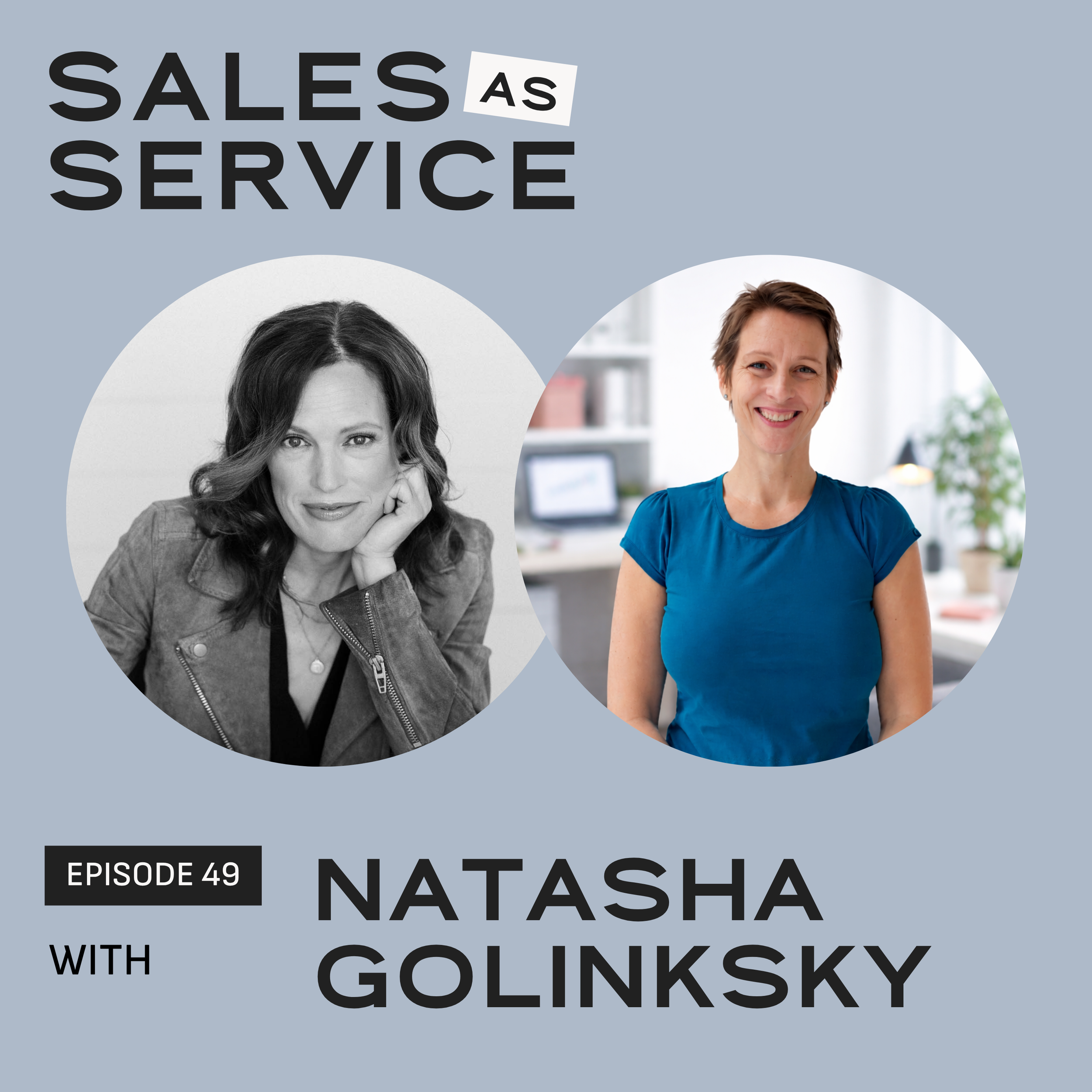
Why You Can't Do the Thing You Know You Need to Do with Natasha Golinsky
EPISODE: 49

Natasha Golinsky is the founder of On Purpose Projects, a certified women-owned full-stack web development agency specializing in complex, custom builds — Shopify, WooCommerce, web apps, and API integrations. She's been running it for over 11 years, built it entirely by accident, and has never written a single line of code herself.
In 2024, a stage two breast cancer diagnosis forced her to step away from her business entirely. What she found when she came back changed how she understood her own role — and cracked open years of work she'd been quietly doing on the patterns that kept her stuck as a founder. That work is now the foundation of her coaching practice, where she helps female founders identify and move through the trauma blocks showing up in their businesses.
In this conversation, Natasha gets honest about what those blocks actually look like in practice — not the dramatic, obvious kind, but the quiet ones that show up as avoidance, perfectionism, and the persistent inability to do the thing you know you need to do.
In this episode:
Why the standard advice to "list your limiting beliefs" misses the point entirely
The one question Natasha uses to surface what's actually blocking a goal
How her own trauma block around visibility kept her from creating content until age 43 — and what finally shifted
Where trauma blocks show up beyond visibility: pricing, hiring, sales conversations, and team building
Why mental health and physical health deserve the same level of attention, full stop
LISTEN TO THE EPISODE HERE 👇🏻
-
[00:00:00] 'Cause I think the thing about trauma is, is you, it's, it's about feeling a lack of safety, right? So when you are in a situation where you feel safe, you're like, "Okay." Like, there's not the fear, right? So after that, I just literally, I published content like seven days a week. Yeah, it'll be a year this next week of, like, actually having the courage to create content on LinkedIn.
Welcome to Sales as Service, the podcast designed to help you change your mind about sales, literally. I'm gonna help you change the way you think about selling. I'm Tam Smith, your host, sales bestie, and pitch partner next door. If you're tired of bros with biceps telling you how to crush a million dollars in your sleep or battling imposter syndrome on your own, you've come to the right place.
All you need to do is listen, then take action. No gym membership required. Let's get started
Hey, Tam here. Most consultants and service-based founders are great at delivery. Referrals prove it, but referrals aren't predictable, [00:01:00] and you've avoided sales because you think you have to be something you're not. But sales isn't pressure or cringey tactics. It's connection, starting conversations, recognizing when you can actually help someone.
The hard part? Doing it consistently. That's why I built the VIP Lead Gen Pipeline System. It gives you a repeatable way to book three to five sales qualified meetings each week through relationship first outreach, not cold pitching. Ready to create opportunities on purpose? Book a free alignment call at studio349.com.
Sales is a practice. Let's make it consistent. Today's guest built a full stack web development agency from scratch, and she's never written a single line of code. Natasha Galinsky is the founder of On Purpose Projects, a certified women-owned agency that's been running for over 11 years. She started it almost by accident.
Someone needed a developer, she found one, and somewhere between that first favor and the next, a business was born. What grew from there is an agency focused on complex custom web development work. Shopify, WooCommerce, web apps, [00:02:00] API integrations, all the technical stuff most agencies don't have in-house.
She built it competently and almost entirely behind the scenes. And then in the fall of 2024, she was diagnosed with stage two breast cancer. Treatment meant stepping back and handing the day-to-day operations of her agency to someone else. What she discovered on the other side, her ops manager had it handled, and she wasn't needed in the way she thought she was.
That moment of forced stillness cracked something open because while she was rebuilding physically, she was also doing something she'd been circling for years. Excavating the patterns that had kept her stuck. Not the tactical stuff, the deeper stuff, the wiring. Natasha has spent a lot of time understanding how unprocessed experiences show up in the way we run our businesses.
Not just the big T trauma that gets all the attention, but the quieter stuff, the childhood rules written into your nervous system before you had any say in the matter. It's that reason a million-dollar agency owner is terrified to post on LinkedIn. The reason a founder with hundreds of DMs in her [00:03:00] inbox never follows up on a single one.
The reason you can know exactly what you need to do and still not be able to make yourself do it. In this conversation, she gets into how to actually spot them, not by listing your limiting beliefs, which she'll tell you is largely a waste of time, but by asking one simple question about the goal you keep not reaching.
This is a conversation about business, yes, but really it's about what gets in the way of the business we're actually capable of building. Here's my conversation with Natasha. Natasha, thank you so much for being here. Welcome to Sales as Service. Oh, thanks, Tam. I'm so excited. Always like to start these conversations off.
Tell us who do you help and how do you serve? Ah, well, excellent question. I have run a full stack web development agency for 11 years. Our focus is generally on businesses that work with e-commerce, whether it's Shopify, WooCommerce, something else, something custom, and we do everything related to the web development.
So whether it's the website itself, building a web app, building a plugin, setting up [00:04:00] APIs, setting up integrations. So all that custom code, complex, critical thinking dev, that's, that's our alley. That's up our alley. You do a lot of work specifically with female agency owners and service-based founders.
How did you kind of like... I guess, what were the common challenges that you saw that made you decide to kind of focus your work there? Well, it was like, the reason that most of our clients at the agency side, like I run two different businesses. So one is the agency work, and then one is my work as a coach with female founders.
Like, but both are female agency owners. So the reason why the agency, we do most of our work white label or in partnership with other female agency owners, is because they didn't... No one had someone in their circle who could code. And so most women, most female agency owners, they would know someone who could do like maybe like, you know, a basic WordPress site or a Squarespace site or a Wix site.
But when it came time that their clients need something a little more technical, they didn't have that person. And so me having run the agency for 10 years, I think I've met like one or two other women who do what I [00:05:00] do, and I'm certified women-owned, and, and it was just this really cool way I could support my peers and my friends and show up for them when the project started getting really technical and they didn't know what to do.
So yeah, that's why I... I love that. I love working with women. It's just, they're so fun, so. And I love kind of hearing people's origin story. You've had a lot of longevity in the work that you're doing. Kind of how did you get started? Oh, yeah. This is like such a funny story, 'cause I'm like the accidental agency owner.
I'm like the- ... coincidental, accidental agency owner. 'Cause like I used to be a management consultant in the nonprofit sector, and I had a client who was looking for help with his website, and he's like, "Hey, could you find me a guy?" And I was like, "Yeah, sure." And you know, I went to Upwork and found a guy from Bangladesh for like eight bucks an hour.
I had no idea what was going on. I didn't know anything about anything. And so he came in and he helped my client fix his website, and then my client was like, "Hey, you know, my partner is actually looking for help with his website. Could you, you know, get your guy to look at it?" And I'm like, "Yeah, sure." And then, you know.
And then literally from there, that's how it all started. And so I run [00:06:00] a full stack web development agency, but I am not a coder, and I have never built a website. So it's very ironic. In the agency world, I'm sort of the opposite because most agency owners are like, "Hey, I was a graphic designer and I got really busy, and then I hired somebody, and now I'm running an agency," where I have never done the thing, ever.
I have no idea what my team does on a day-to-day basis. I know how to build teams, I know how to lead, I know how to manage, I know how to like do all that, so that's my, my lane. I stay in my lane. I'm gonna kind of pick your coaching brain- Yeah ... for a second. You speak specifically about the tra- like trauma blocks showing up in business.
How do you define that in a, in a way that founders can actually recognize it in themselves? Yeah, that's a great question. So to kind of bridge how the coaching came to be is I was running the agency, and then in the, in the fall of 2024, I was diagnosed with stage two breast cancer, and I had to hire somebody to come and run my agency for me.
And so I was, as you know, like, I was in treatment, I had surgery, I had chemo, I had, like, tons of, like, infection after chemo. [00:07:00] And, and so I was-- came back, and, like, finally when I came back from treatment, and my, my ops manager told me, she was like, "Look, I got this. I don't need you. Like, you do you, right?" And I was like, "Oh my God."
And so I-- something I'd been working on behind the scenes was, with my peers, with myself, was, like, female founders overcoming trauma, overcoming, like, overcoming what keeps us so stuck so that we can lead. And I like to explain it like this. Like, this is, I find, a really good example of what that looks like, 'cause I think a lot of people over-- like, they, they overthink trauma.
And so for me, I always use this example of me as a content marketer. So now people know me, and they're like, "Oh my gosh, you create so much content. You have so much to say." And I was like, "Well, that was not always the case." Like, until-- when I was 43, so two years ago, I was working with-- I hired a content marketing coach.
And I remember she was trying to get me to create content, and I was, like, physically ill. I was like, I couldn't do it. I was having panic attacks. I was having nightmares. And so literally after our f- I bought, I bought like eight blocks, eight lessons with her, like eight coaching sessions with her. And I [00:08:00] remember after the first one, she was like, "Look, I'm just gonna give you a refund because you cannot do this.
Like, I can't even work with you. Like, you're so stuck." And I remember I was like, "What the fu-" Because I was like, I have so much to say. I am not the kind of person, I'm not shy, but I couldn't do it. I literally could not. So I remember I was working with a therapist, and I was like, "This is something I wanna do.
I think I'd be really, really good at it, but I just, I cannot bring myself to, like, write or share or record or anything." And so we did a bunch of, like, work on it. And the end of the day, what turned out was it went back to when I was a kid. Like, I was raised with a bipolar parent, a really devout, judgemental Catholic mom, and it was really grew up in this situation, like, don't rock the boat.
Don't make anybody mad. Like, keep, like, just keep the peace. It doesn't matter. Like, what you want doesn't matter because you gotta think of the team. 'Cause I had five younger siblings, so I had to kind of, like, maintain the peace in the household, right? So nobody got triggered, nobody got mad. And so that made a lot of sense that when I wanted to create content, I'm like, that [00:09:00] wiring to, like, don't make anybody mad, keep the peace, don't say anything that's gonna trigger anybody, like, that was it.
Like, and to me, that was a huge trauma block that I was like, I couldn't. And I was 43, and so finally, when I kind of got over that and learned, like, no, you're safe now. Like, I haven't lived with my parents for, like, a long time, right? I'm like, you're safe now. It's okay. Like, you can handle somebody being mad.
Anger does not equal danger anymore. And once I could finally, like, integrate that, I was like, oh my God. And now I literally could publish, like, 25 times a day. And I don't, because nobody wants to see that much content from me, but I could, and I do. You know? And so it's like that's how I define, that's a, that's my best from, one of my biggest from my life of, as a female founder, where is that happening but you don't know why?
And obviously it's not just content. It's anything, right? It's anything where we're stuck, and we're like, we don't know why We can't fix it. And, and it's a subconscious, and it's like, so [00:10:00] now that I'm, I'm overseeing the agency side, like I'm overseeing, I work with my managers and stuff, but right now, like I am in a huge mode where bringing this out because I've been a female founder my entire life.
I've never had a job, and I know from firsthand experience like how much trauma keeps us so stuck. So I'm on a mission to like help women like shine brighter and bigger, and so that's what the long answer to your question, so. Well, no, it's great. And w- where do you see it, you know, outside of just, you know, showing up in visibility in the business?
Where are some of the other places where you see, uh, it showing up in, in just in the practical day-to-day? You know, is it, you know, pricing, hiring, sales conversations, boundaries? So many things. Like I can give another example. Like I have a friend, a good friend of mine, and she has over a million followers on TikTok, and she makes zero money.
Like absolutely zero money. Like I think she made $10,000, you know, last year or something. And, and I talked to her and I'm like, "What, what are you doing?" [00:11:00] Like, you know, "You're so good at what you do." She's so talented. Like, and she'll package up an offer, and she'll promote the offer, and she'll get like hundreds of DMs, but she never follows up with them, and she never reaches out to anybody.
And, and I'm like, "You have money sitting in your inbox. Like what are you doing?" And she's like, "Well, I don't have time. I'm busy. I'm working at my church." And, and I'm like, "Oh my God." I'm like, "Get some help. Like get a VA. Like if you're busy, like either like don't be as busy or hire some help to just filter it out and send you the best leads, and then, you know, the spam ones, delete them, and, you know, keep...
Tire kickers, get rid of them. But the ones who are like legit and wanna start, like have her send them to you." And she's like, "Nah, it's like too much work to hire somebody." I'm like, "Oh my God." But I know her. I've known her for like 15 years, and she has major blocks around team building Like, major blocks.
Like, she's a control freak and she doesn't believe anybody can do it as good as her. And I'm like, no matter how many times I've told her, like, say I, I'm all about team building, it's like, there are six billion people in the world. Like, there's someone in the world who can do it as good or better than you.
Like, I [00:12:00] guarantee you. For not that expensive. But she won't do it. She won't do it. And so, like, she's constantly questioning whether she can show up as an entrepreneur, whether she can succeed, whether she should give up. And I was like, but it's the trauma block is the control freak, the perfectionism, the team building, and until she gets therapy there or help there, she can't.
Do you see what I mean? Like, it's like, so talented and, like, it's not easy to create a million fo- I think she could put together a million followers in two years. Like, it's amazing. And, and, and no, but I'm like, she can't make money because she won't... She hates sales and she won't build a team. And I'm like, "You're done."
Like, you're done. Like, you can't. So, but it makes me, it makes my heart, 'cause I, I look at her and I know her and I love her, and I'm like, "What are you doing?" In, in working with someone, how do you help them identify and move through that? It usually works, it usually shows up where someone is, like, really stuck.
Like, someone is like, "I've set this goal for year after year after year, and I'm not getting it." And they've tried everything. They've done the coaches and the cohorts and [00:13:00] the coaching. And, like, I know for me, I've spent definitely more than six figures on coaching and personal development and stuff like that.
And, and honestly, it hasn't really had a lot of measurable growth because of my own blocks and different things, right? But it usually looks like they've tr- tried all the practical things, pragmatic surface level things to, like, fix it, but it's not working. And, and the part about trauma, Anne, is that, you know, when we read these books, right?
And we've all got it. And we all... Everyone does. Yeah. Everyone in the world does. And it's like, I think a lot of people get confused about, like, big T, little t, because for a long time, I really didn't identify with the word trauma because I had never been gang raped, I'd never been a child soldier, I'd never been, like, abused or physically abused.
And so I, like, really... People would tell me, like, "Okay, you have serious PTSD about certain things," right? And I was like, "No." Like, I just thought it was normal, you know? Like, growing up how I grew up. And they're like, "No." And now that I've done a lot of certification work about being trauma informed and, like, all these things, I'm like, there's big T trauma.
Yes, [00:14:00] I've been a child soldier and murdered my parents, let's be real, right? Or there's, like, little t trauma, like, okay, somebody laughed at you and you put up your hand in school. But it's not like... It's honestly, it doesn't mean... Trauma is anything that kind of affects you and, and keeps you from, like, living the way you wanna live.
So we just look at that. And it's like, the problem that I have with that is, like, there's so many books about personal development that are like, "List all your limiting beliefs." And I'm like, I think that's total bullshit because it's like, if we knew, we wouldn't, we would know. We don't know. Right. And I think I wrote about this week on LinkedIn, but I said, like, the best way to do it, one of the best ways that I love to do it is, like, mention your goal.
Okay, my goal is to have a six-pack, whatever, like body like- Yeah ... I used to. I used to. But, you know, through menopause, after chemo, like my body is like very different now. And I'm like, "Okay, I still wanna have that six-pack abs that I used to have," but w- and then you ask, okay, here's the... That's the goal, right?
It could be any goal, right? And then you ask yourself, "Why can't I have that?" And then immediately, [00:15:00] it starts coming out. Well, you know, I'm too tired to really work out anymore. Hey, I've got the menopause belly. Hey, my hormones are out of whack. And like all of a sudden, I now have three things, three beliefs in my head that are my blockers, right?
Are there millions of women after menopause who have six-pack? Yes, they do, right? So but my stories are my blocks, and so the idea is we look at them and we're like, okay, like... And some of them might be more surface level, like not as hard to like debunk, right, or to like dig through. But some might be big, right?
Like no one in my family has a six-pack, and that's like, you know, could be generations of conditioning, right? Like we just are... No. You know? But yeah, so that's usually how you do it. It's just a question like, "Why can't I have this?" If your pipeline feels inconsistent, it's usually the sign of an outreach gap.
I created a free tool called the New Client Calculator to help you see exactly what it takes to land your next client. How many messages? How many conversations? How many follow-ups? No [00:16:00] guessing, just clarity. If you've ever wondered, "Am I doing enough or just not doing the right things?" This will show you.
Head to studio349.com to download the New Client Calculator and find out just how close your next client really is. All right, let's get back to the episode. And I appreciate the point you made about, you know, big T, little t, 'cause I think it's so quick to dismiss. But you and I are both fortunate that we don't have, you know, that big T history.
But you know, it's easy to dim- dismiss or dis- disvalue or not value, you know, the, those underlying beli- you know, beliefs that are keeping you stuck. You know, the, the little t that, you know, that are just as causing that same kind of challenge in your life. You know, just to, to completely underestimate that and not, not honor it.
Yeah, for sure. When you've done the work, you know, to actually like look at, you know, okay, the goals you've set, you know, that you're, you know, for whatever reason consistently bumping up against these blocks, not able to hit, and you've, you've done the work, what does it look like when you start to being able to [00:17:00] translate that into like tangible outcomes?
Like, can you share a, you know, a success story, if you will, or someone you've worked with that, you know, you've moved through that together, what it looks like on the other side? Yeah. Well, I can use my example of the, of the content. You know, the content creating, like 43 years, and I've always been kind of like how I am.
Like always have an opinion, always have something to say. I'm the queen of unsolicited advice. Like, you know, and it's like I've always been that person and I- Just couldn't. And I'm brave. I am brave as hell. You know, like, and I just couldn't. And so it looks like, on the other side, it's like you look back and you're like, "Why did that...
I don't remember being like that." You're just, like, on the other side of it. You're just like, don't even think twice. You know? I, I don't know. It's like now, it's like for me to create content, it's like I write whatever the hell I want, you know? Like, I write about cancer, I write about menopause, I write about a fight with my partner.
Like, in a funny way. Like, I write about it in a way where there's a lesson, there's some sort of reason I'm saying something. It's not like, "Oh, I had a fight." But it's like now, [00:18:00] I, I can be vulnerable and open and transparent and committed to helping other people and sharing from my story, where before, like, literally I would throw up.
Just the, at the idea of recording, like, a TikTok video. Like, could not. What was the original assignment with the coach that you were working with? What was the original- It was to, like... I think it was, like, identify your content buckets, and that was enough to, like, freak me out. It was, it wasn't even, like, recording anything.
It was just like, "Let's identify your content buckets on, like, what you wanna talk about." And I was just, like, sick just thinking even about it. So yeah, I mean, it, it could be anything. You know, I've looked at it, and so many times, like, being raised by a bipolar parent, the kind of people that I had in my life, the kind of guys I would date was just...
It was a train wreck, right? Because that, to me, and I'm sure a lot of women can relate to this, like, you know, when you're raised by someone who's unstable, like emotionally unstable, that unfortunately, as a kid, as a whatever, being [00:19:00] raised like that, that becomes your version of normal, no matter how dysfunctional.
So when you date somebody who's really nice and really respectful and kind, you're like, "This is boring." Because, and then you're really attracted to that guy who's, like, the bad boy and really unstable and very unavailable and treats you bad. And, like, that to you feels like, okay, this is normal. And even if you don't like it, it feels safe and it feels normal, and it's like- It's what you know
it's what you know. Yeah. Yeah. And it took me decades to, like, get over that. You know? And now, the partner I have is, is a great guy. Like, and I'm like, "Oh my God. Thank God. This is boring," right? Like, you know, more boring than- Yeah, right ... being with, like, ridiculously crazy. But- Right ... but I remember telling my mom, like, 'cause I was dating a guy for a long time and she didn't like him.
And she was like, "Why, what do you see in this guy?" And I'm like, "Oh, he keeps it interesting," because he was seriously, like, unstable, that guy. But now I look at it and I'm like, "What the fuck was I thinking?" But it's like trauma. [00:20:00] It's a trauma response, right? Yeah. 'Cause your body, your nervous system, is used to being in a certain environment.
Yeah. And so, and, and women like that, you know, it's like we have to be very, very careful to not create chaos unconsciously, because chaos And unst- instability is, like, what feels normal to us. Mm-hmm. So it's like- And- ... do we subconsciously do that? You know, it's like, oh my God. Well, a- and I see so much of it, you know, with the, with the clients I work with as well, you know, from the, you know, the fear of being visible piece to the, you know, asking for the opportunities that we want, you know?
We're very comfortable waiting to get found and waiting for someone else to, to choose us, and to kind of that external validation that we have, we have value, you know, waiting for someone else to, like, to tell us that versus, I mean, being able to make that choice for ourselves. And kind of what was, what did that first moment of when you started putting yourself out there to be more visible, like, what, what was that first moment [00:21:00] like?
And, and, and I'm guessing that it's just been, like, does it still feel a little uncomfortable? Has it just been through kind of that repetition and practice? Yeah. I had to start, like, how I started, honestly, was not some big miraculous like, oh. It was like, I just started by commenting on people's stuff. Mm.
Mm-hmm. Like, I didn't even feel I had enough to say to add a comment. Mm-hmm. Like, so, like, I think it was that, and I'm like, oh my God. Like, and so I remember I first started by like- I don't know this version of you, by the way. I think I know, right? Most people don't. They're like, "Oh my God, you're so brave."
And I'm like, "Oh my God." No, but it was like, I remember like last year, this was not that long ago, I, I, I remember Mol- I have a friend named Molly Godfrey, and she's like the LinkedIn queen, right? And we were chatting, and I'm like, "Look, I'm seriously stuck here." And she's like, "Why don't you just start by something simple?"
Like, like, after I'd kind of gotten through it and I was ready, and I was like, "Okay." And, and sh- I started, like, two weeks of just, like, adding a comment to somebody's thing. Like, reading my feed and adding a comment. And even then I was [00:22:00] feeling so anxious, just like- You know, just saying anything to anybody Mm-hmm And, and then so I got in, I was like, "Okay, I'm adding comments, I'm adding comments."
And then I, I remember, like, I just, I was started posting content, and I was kind of being dumb about it, like I was using AI, and I, I don't know, I didn't really know how to have a voice, right? I just like, okay- Yeah ... let me just publish something. And then I remember there was, like, this one post where I posted something like...
It was like, I'd finished chemo. This was, like, last April. And I remember I was, I posted like, "Hey, just so happy to be finished chemo," and I was so scared. And it was posted with a picture of me and my partner sitting in the chair at chemo. I had no hair and, you know, I was still kind of hooked up to the IV and stuff, and I was, like, on my last day of chemo.
And I remember I got, like, 200 comments on that post like, "Oh my God, way to go. Oh my gosh, Natasha, I had no idea. Like, sending you so much love," and it's all this stuff from people that I knew. Mm-hmm. And I felt so supported and so safe and so like, oh my God, like, what have I been doing? Like, what have I been doing?
What am I so scared of? [00:23:00] Mm-hmm. Like, and, and, and somebody told me too, they're like, "If somebody's an idiot and posts a stupid comment, just delete it." Like, and I remember thinking, okay, I don't have to deal with the trolls, I don't have to deal with the hecklers. Like, I can just delete it and, like, forget it, right?
I don't have to respond or handle it. So since then, I was like, okay. Like, I just felt so... 'Cause I think the thing about trauma is, is you- It's, it's about feeling a lack of safety, right? So when you are in a situation where you feel safe, you're like, "Okay." Like, there's not the fear, right? So after that, I just literally, I published content like seven days a week, and now I'm like- Mm-hmm
how do I... Like, exactly. I'm like, like I wanna publish like five times a day. But I'm like, "I can't." I have so, I have so much content now. I'm like, "Oh my God." Like, my assistant is like, "Enough with the content. Like, we have enough content. Stop creating new content." So, but yeah, it started small. It started small, and now people who know me, they're like, "Oh my God," like, "you're so good at content."
I'm like, you have no idea, like the backstory of... It's been not even a year, or- Yeah ... yeah, it'll be a year this [00:24:00] next week of like actually having the courage to create content on LinkedIn, or anywhere. Like, you know. W- w- you're such a great example because you have such a depth of experience. You know, from your professional life to your lived experience, and, you know, just in kinda the, the whole meaning behind, you know, sales is service.
Like, if you have a level of expertise, a product to service, you know, something to share that will help someone t- with a ch- problem that they're, you know, challenged with or achieve a goal, you know, I'm, like we have a, you know, an obligation to, to share that, and you're really, you know, you're, you're living that example, so thank you.
A- and, and, you know, and, and working through the, the discomfort of doing that when it didn't immediately come. Like, you know, we're, we're not all, you know, naturally... We're not all influencers, or, you know, e- easy influencers, put it that way. But we all have gifts to share. That's it, right? That's what I would see, because I knew.
Like, I knew, like, I could help. Like, I knew I [00:25:00] could. Like, I've been in the female agency world for a long time, and I know my peers. Well, all my peers, my friends, my colleagues, they're all female founders, and we would talk just as friends behind the scenes, and I would get calls of them crying, and I would like handle these situations, and I knew them, and I would have these conversations.
And, and I'm like, "I know, I know I have something to say." 'Cause like, I know I do, because people would reach out to me, and they'd like want my input on things, and I was like Like, and I just, and I know, like, I'm funny, and I know I have, like, kind of a slanted sense of it. And like you said, I've lived it.
I'm not talking as a coach from, like, blah, blah, blah. Like, no, I have been in it every single day for, like, over a decade. Like, I know what I'm talking about, right? I have a really good friend of mine, and she also, she runs this agency, like almost a million-dollar agency, and she's wanted to, like, create content on LinkedIn.
She works in a CEO. And she's like, "I just can't. I can't. I'm so afraid of people, like, badmouthing my opinions on SEO." And I'm like, "Oh my God, you're at a million dollars. Like, how can you be afraid? How can you be afraid?" Right. [00:26:00] Like, what are you talking about? You have like 20 people on staff. Like, what the heck are you afraid of?
And I l- and literally this week we had this conversation. She's like, "Can you give me some advice on LinkedIn? I'm too afraid to, like, post on LinkedIn." I'm like, "Okay, like, it doesn't just, like, go away, right?" It's like- No ... she's so badass. Like, she's so brave, and she's so empowering and, like, but we have these things in our head, right?
Like, and I'm like, oh my God. Like, it's just at any level, right? We f- and, and probably from her, similar, right? So if her ex- her, her reasoning is someone's gonna be mean to me if I publish something, well, probably in her life when she had something to say, someone was mean to her, you know? And someone, like, pushed her down when she tried to show up.
And I'm like, "Okay, let's find that. Where is that?" A- and, like, for anybody, like, you think the, the percent of women, you- it's such a small fraction of female entrepreneurs that actually hit that six-figure level, and then even a smaller fraction that hit that, you know, million-dollar level. Like 2%. I mean- Yeah
yeah, anyone that, you know... I [00:27:00] appreciate you sharing that, that, you know, it, it never necessarily fully goes away- No ... you know, regardless of what level you're at. No. Exactly. Um, well, for the founder listening who feels stuck and can't explain why, what's the first thing you'd want them to consider? So, what I would first of all consider is, like, there's, there's two ways to go about it.
I mean, on one hand, like, you can do sort of self-analysis, which I can talk about in a second. Or if you're really, really stuck and you feel like there's been some... And you're aware that there is probably a trauma or something, I always encourage people, like, mental health is like physical health. If you break your leg, you're gonna go to a doctor.
If you need help n- with your mind, see a therapist. Like, I don't know about you, Tam, but, like, mental health to me is not taboo. No. Mental health, physical health- Mm-hmm ... it's the same. It's the same. Yeah, same. If you're hurting, like, it's the same. There's no taboo. It doesn't mean you're broken. You're not crazy.
Get help. Right. I mean, that's one of my messages is like, see a therapist. There's nothing wrong with you. If you were sick, you'd go to the doctor. If your, like, [00:28:00] thinking is sick, go see a therapist. That's it. Yes. So, I think, like, yes, if you know you're stuck, if you're afraid bec- and you know, you probably know why.
There was some sort of bigger T trauma or something, definitely see a therapist who can help you work through that. But if you know that it's, like, quote, unquote, like, not that deep, like, do you know what I mean? Like, for me, like, I've never been abused. I never... So I'm not saying, like, it's at everyone's discretion, obviously.
Like, one thing that I love to do is I actually use, like, Claude AI and we chat, and I'm like, "Hey. Hey, y'all. Like, this is, this is what's happening. Like, I'm incredibly afraid to..." Dot, dot, dot. And, and I've ch- I've had enough, I kind of have tr- learned, like, started treating my Claude like my journal. So, like, most, a lot of days I'll go in or, like, when I'm feeling triggered by something.
And so Claude has kind of, like, learned how I think. Like, it's been really interesting, and obviously it's AI. It's not God. But it, it's, like, no replacement for medical advice, right? But it, a lot of times, gives me really good feedback. You [00:29:00] know, something like, I remember when my ops manager took over the agency, and I was feeling really sad.
Like, I was excited. I was excited that I didn't have to run the day-to-day anymore, like, two FA validation was behind me. But, like, I was really sad, and I didn't know why. I'm like, "What are you..." I've wanted to be out of this role for, like, five years. Like, what am I sad about? Like, I, I just felt so down, and I didn't know why.
And you're responsible for the success of being able to transition out of that role. Exactly. Yeah. And I was like, "Okay, I had, like, a partial exit. That's a huge win. Like, what is the problem?" And I was, just felt so stuck, like, I didn't know what to do. I was kind of, like, wandering around my house. I'm like, "Now what do I do," right?
And I had this idea that I wanted to talk about the trauma piece, but I was so stuck. And same thing, I was so afraid of, like, what that would look like, right? To, like, make a brand pivot, quote, unquote, right? 'Cause everyone knew me for, in the web space. No one knew me in the trauma space. And to make that pivot and to, like...
I remember the day I updated my LinkedIn profile to, like, change my banner, change my header li- like, change my positioning on LinkedIn. [00:30:00] I was, like, so sick. And I remember, like, working through that transition- I was using my AI chat all the time. I was like, "Hey, I am terrified." And they're like, "Of course you're terrified.
You know, this is a big change. You've been doing the same thing for 10 years. Of course you're scared. Fear is normal. Like, how can I help?" You know? And we were having this conversation, da, da, da, da, da, with AI, and I was like, "Okay." They're like, "Look, why don't you..." You know, and it was just so helpful. Like, it's kind of like a thinking partner, right?
Yeah. Yes, that's how I think of it, as a thought partner. Yeah. Yeah. And it can, like, pull resources from, like, or something, and it can pull resources offline, and it understand. Like, you can say psychology, and it has all these references to things. And I was like, okay. And I find for me, sometimes just, like, having someone to kind of like talk you back and forth.
And I don't know why my AI all of a sudden started getting really lippy with me. And I'm like, "No, you do not talk to me like that." And it's like, "Hey, sorry. No worries. I was just trying to give you a little push." I'm like, "No, that is not gonna-" My AI is very, like, ballsy. I don't know about yours, but mine is like, "Mm."
You've trained it well. A little bit of [00:31:00] attitude sometimes. I'm like, "Today is not the day for attitude, friend." Like, "No, today is not that day." But no, I find that really helpful to me. Like, if I'm feeling stuck and I, I don't know why, it's a really great thinking partner. But I also have spent I don't even know how much money on therapists, and energy workers, and healing and stuff because it's...
If you can't fix it yourself, you absolutely need to escalate- Get help ... and like- Yeah ... seek, talk to somebody, right? Well, let's jump into our fast five. Your I can't live without it software or app. Slack. Best advice you've ever received about sales and business development. Just have fun. Relax, have a conversation.
Your morning routine must-have. Extra hot coffee with caramel macchiato creamer with, like, dark roast coffee. Yeah. Your walk-on song, the one song that always pumps you up. Oh, I was thinking about this song. I, I was like... You know, there's a song in Trolls, the movie Trolls. It's like, "Get back up again." So cute.
Sung by the troll going to, like, get help. That's my song. Like, I just... I love- When I get depressed, I, like, put that song on repeat. I'm like, "Okay." [00:32:00] And if you only had one hour each day for business growth, how would you spend it? I would spend it commenting on the posts from the women in my community, like cheerleading all of them.
Thank you so much for being here, and I so appreciate how transparent you've been just with, you know, your challenges and your struggles. I think, you know, from the outside in it's easy when you see entrepreneurs, you know, female entrepreneurs that have achieved, you know, a level of success that you, you, you don't see everything that came before it.
And, and I appreciate you being so open and transparent to, you know, to talk about the challenges that have come with that, as I think it, I think it's something like we can all relate to and, uh, and that there's a way through it. So where can people find and connect with you online? Yeah. Come find me on LinkedIn.
If you're a female founder listening to this, I have a free Slack community where we talk about all this stuff, the trauma, and the healing, and the breakthroughs, and the mindset shifts. So through my LinkedIn profile you'll find an invite to the Slack community, and I would love to have you there, so.
Awesome. We'll be sure to link it in the show notes, too. Thank you again so much for being here. Thanks, Tana. Oh, [00:33:00] my pleasure. Thank you for having me. Thanks so much, Natasha, for this conversation. What stuck with me most is the simplicity of what she said about identifying what's actually blocking us. Not journaling pages of limiting beliefs, not hiring the next coach.
Just sitting with one basic question: Why can't I have this? Because so much of what keeps us from doing the sales and business development work we know we need to do isn't a strategy problem, it's a wiring problem. And you can't outwork it. You can't out tactic it. You have to really look at it. Which brings me to this week's Sales as Service challenge.
Pick one business development action you've been consistently avoiding. Not the thing you're just procrastinating on, that thing that creates a specific, almost physical resistance every time it comes up. Maybe it's sending a connection request to someone you genuinely love to work with. Maybe it's following up after that discovery call.
Maybe it's simply posting something on LinkedIn that actually says something. Now ask Natasha's question, "Why can't I have this?" [00:34:00] Don't filter it or overthink it. Don't try to clean it up. Just write down whatever comes up first, because that's usually the thing worth looking at. And then take action anyway.
One time. That's it. Confidence doesn't come from feeling ready. It comes from doing the thing before you feel ready and learning you can survive it. If this episode resonated with you, I'd love to hear what came up. Come find me on LinkedIn and let me know. And if you know another female founder who needs to hear this conversation, be sure to share it with her.
And be sure to finally connect with Natasha on LinkedIn and join her free Slack community for female founders. The link will be in the show notes. All right. That's it for me this week. I'll see you next time on Sales as Service. You've just listened to the Sales as Service Podcast, the podcast to help you shift your mindset around selling.
If you liked what you heard, be sure to hit subscribe and share it with a friend, because we're all about more sales awesome and less sales awkward. See you next [00:35:00] episode
MORE OF A READER? 👇🏻
Most founders reach a point where the practical fixes stop working.
You've tweaked the website. You've tried the content strategy. You've hired the consultant. And still, there are things you know you should be doing for your business — outreach, follow-up, showing up more visibly — that you just can't seem to make yourself do consistently.
The easy answer is discipline. The honest answer is usually something else.
Natasha Golinsky has spent years looking at that something else. As the founder of On Purpose Projects, a certified women-owned web development agency she's run for over 11 years, she's had plenty of time to observe what actually stops capable, experienced founders from growing the way they're capable of growing. And it's rarely a strategy problem.
In 2024, a stage two breast cancer diagnosis forced her out of her own business. Surgery, chemotherapy, and a long recovery meant handing off operations entirely. When she came back, her ops manager had everything running. She wasn't needed in the way she'd assumed she was. That forced exit became a turning point — not just for how she ran her agency, but for the deeper work she'd been circling for years.
That work centers on what she calls trauma blocks: the unprocessed experiences that get wired into our nervous systems early and quietly shape our behavior as adults — including how we run our businesses. Not just the obvious, capital-T trauma that gets talked about openly, but the quieter conditioning. The household rules that said don't make anyone uncomfortable. The early experiences that tied visibility to danger. The patterns that feel like personality but are actually just protection.
These blocks don't always look like emotional distress. They look like a founder who has hundreds of unread DMs from people interested in her work and never follows up on a single one. They look like a million-dollar agency owner who can't make herself post on LinkedIn. They look like someone who sets the same goal three years in a row and hits a wall every time — not because she lacks skill or commitment, but because something underneath keeps pulling her back.
Natasha's approach to identifying these blocks is refreshingly direct. Forget the standard advice to journal your limiting beliefs. If you knew what they were, she points out, they wouldn't be limiting you. Instead, she starts with the goal — whatever you keep not reaching — and asks one question: why can't I have this?
The answers that come up immediately, unfiltered, are the data. Some will be surface-level and easy to work through. Others will point to something deeper that might benefit from professional support. Either way, you now have something specific to look at instead of a vague sense that you're somehow getting in your own way.
She's lived this herself. Until her early forties, Natasha couldn't create content. Not for lack of having something to say — she's always had opinions and the confidence to back them up in person. But the idea of writing or recording anything for a public audience triggered a physical response: panic attacks, nightmares, a complete inability to start. A content coach refunded her after one session. It took working with a therapist to trace it back to childhood — growing up with a bipolar parent in a household where keeping the peace was survival, where having something to say that might upset someone wasn't safe.
Once she understood that the wiring was old and the danger wasn't current, things shifted. Within a year she was publishing consistently, building a Slack community for female founders, and doing the work she'd always known she had in her.
That's what's on the other side of this. Not a personality transplant. Not becoming someone you're not. Just the version of you that isn't quietly working against herself anymore.
If you're a female founder who keeps bumping up against the same walls, this conversation is worth your time.
✦ YOUR SALES AS SERVICE CHALLENGE
This week's challenge is simple — but it will tell you something.
Pick one business development action you've been consistently avoiding. Not the thing you're procrastinating on — the thing that creates a specific, almost physical resistance every time it comes up. Sending a connection request. Following up after a discovery call. Posting something on LinkedIn that actually says something.
Got it? Now ask Natasha's question: why can't I have this?
Don't filter it. Don't clean it up. Write down whatever comes up first — because that's usually the thing worth looking at.
Then take the action anyway. One time.
Confidence doesn't come from feeling ready. It comes from doing the thing before you feel ready and learning that you survived it.
RESOURCES & LINKS
Learn more about On Purpose Projects
Connect with Natasha on LinkedIn
Simply sales with the VIP Power Hour - download the FREE guide
Learn how to consistently book 3–5 sales-qualified meetings each week - book an Alignment Call
SUBSCRIBE & REVIEW
If you loved this episode, please take a moment to subscribe and leave a review on Apple Podcasts! Your support helps us reach more creative agencies and service pros who need these insights. Thanks for tuning in to Sales as Service—see you next week!

TAM SMITH
I’m Tam Smith-Sales Growth Strategist and Founder of Studio Three 49. I help service-based founders find, connect with, and convert right-fit clients through predictable, sustainable outbound sales solutions.
No pushy pitches. No bro-marketing. Just simple, structured systems that turn connections into clients.